65 Days
Why we rowed an ocean
We did not cross the Indian Ocean to collect a trophy. We crossed it to prove something anyone can use: that ordinary people, with the right mindset and the right team, can do extraordinary things.
That was the mission from the first stroke: forge endurance, add confidence, inspire others to take on their own untamed challenges.
The ocean tested exactly that. Here is what actually happened.
The crossing
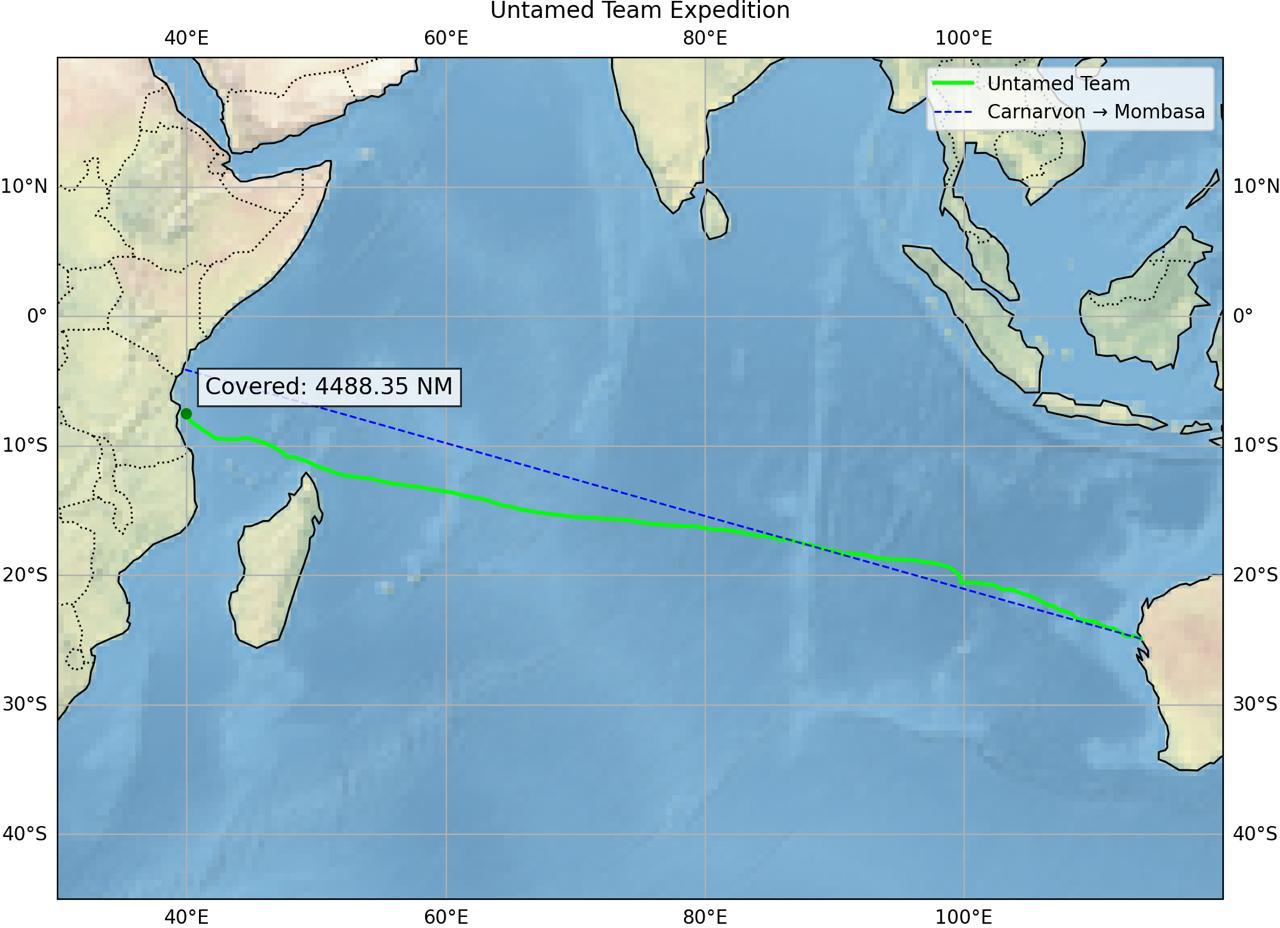
On 17 May 2025 at 09:15 UTC, four rowers pushed off from Carnarvon, Western Australia, into the Indian Ocean.
On 21 July 2025 at 19:57 UTC we stepped ashore at the Yacht Club of Dar es Salaam, Tanzania.
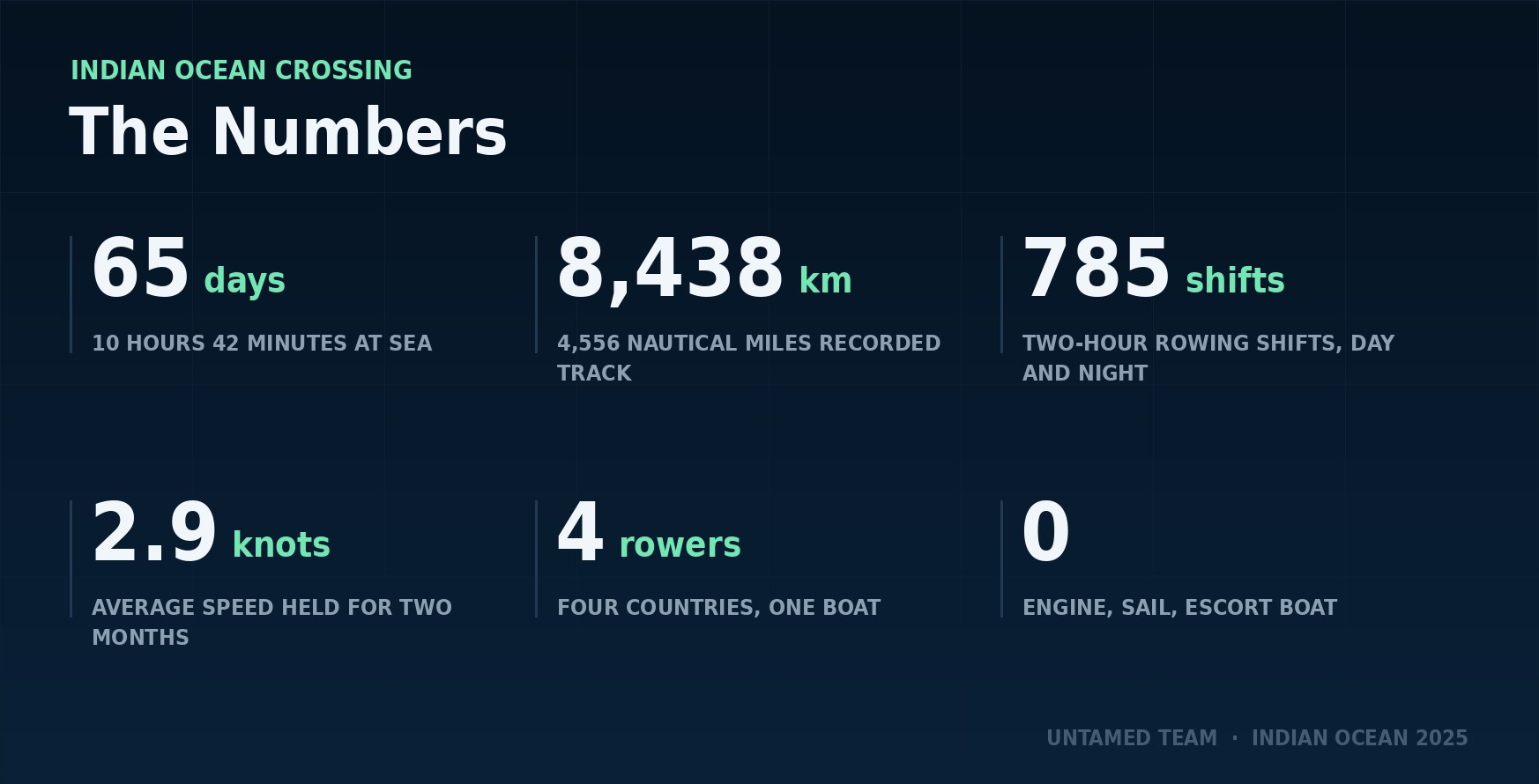
In between: 8,438 kilometres of open ocean. No engine. No sail. No escort boat. And not one full night of sleep.
The numbers
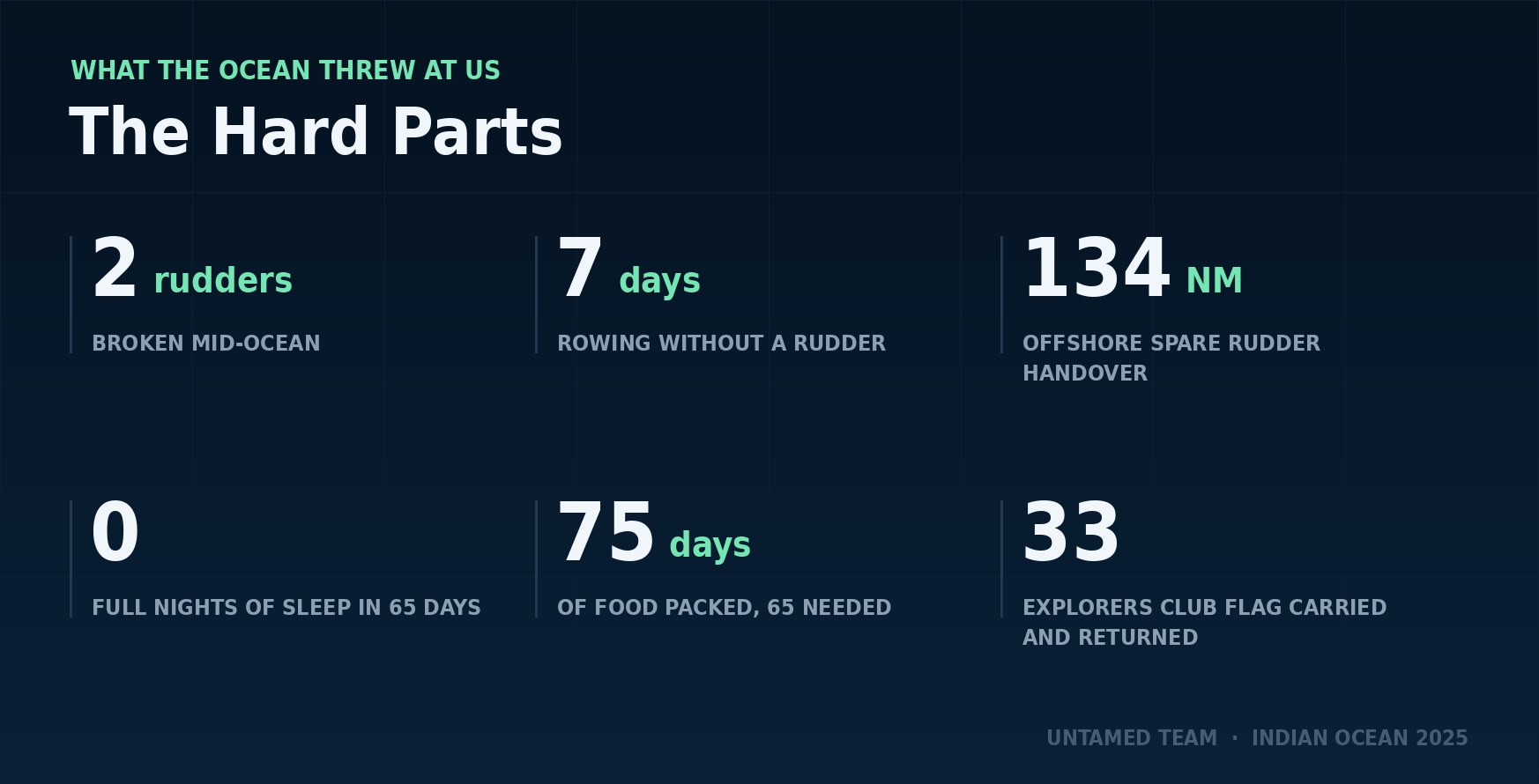
Four rowers from four countries. 785 consecutive two-hour rowing shifts, day and night, none missed. Average speed about 2.9 knots: walking pace, held for two months without stopping. We packed food for 75 days. The ocean let us through in 65. It took its price in kilograms too: Evgeniy alone lost 25 kg over the 65 days.
When everything broke
Our steering had been in trouble since the first month. On 6 June the main rudder broke; a coin flip decided who dives, and we fitted the spare mid-ocean. On 18 June the centreboard broke. And then came the night of 12 July.
At about one in the morning, twenty minutes after Stefan and I had handed over our shift, a heavy wave threw the boat onto its side. Liu went overboard. His safety line held, and Ralph and Stefan pulled him back aboard. The handle of my cabin door broke in that moment, and I was locked inside while it happened. At dawn we lowered an underwater camera and saw what we feared: the spare rudder was gone, and the centreboard with it. Nine days from the finish.
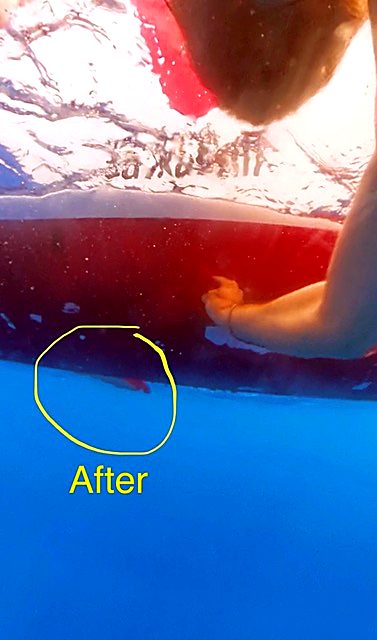
The underwater check: where the centreboard should be.
For the first few hours we were in shock. We talked seriously about calling for rescue. Wind and current were pushing us north, away from Tanzania and toward the Somali coast, and the regional maritime security centre had explicitly warned crews about piracy along that shore.
This is the moment every big goal has. The plan is gone, the tools are broken, and the only question left is who you are without them.
Then we tried something instead. We turned our seats around, faced the stern, and rowed backwards. The boat steered. The position was awkward and the stroke weaker, but we had speed and we had a direction. One fear stayed with us: that the strong Somali current would push harder than we could row without a rudder.
We rowed like that for seven days, backwards, holding course with muscle and stubbornness.
Mombasa, Kenya, had been the plan from the start. But with jury-rigged steering, a shaken crew and the Somali current waiting in the north, the seamanlike answer was the nearest safe mainland finish: Dar es Salaam, Tanzania.
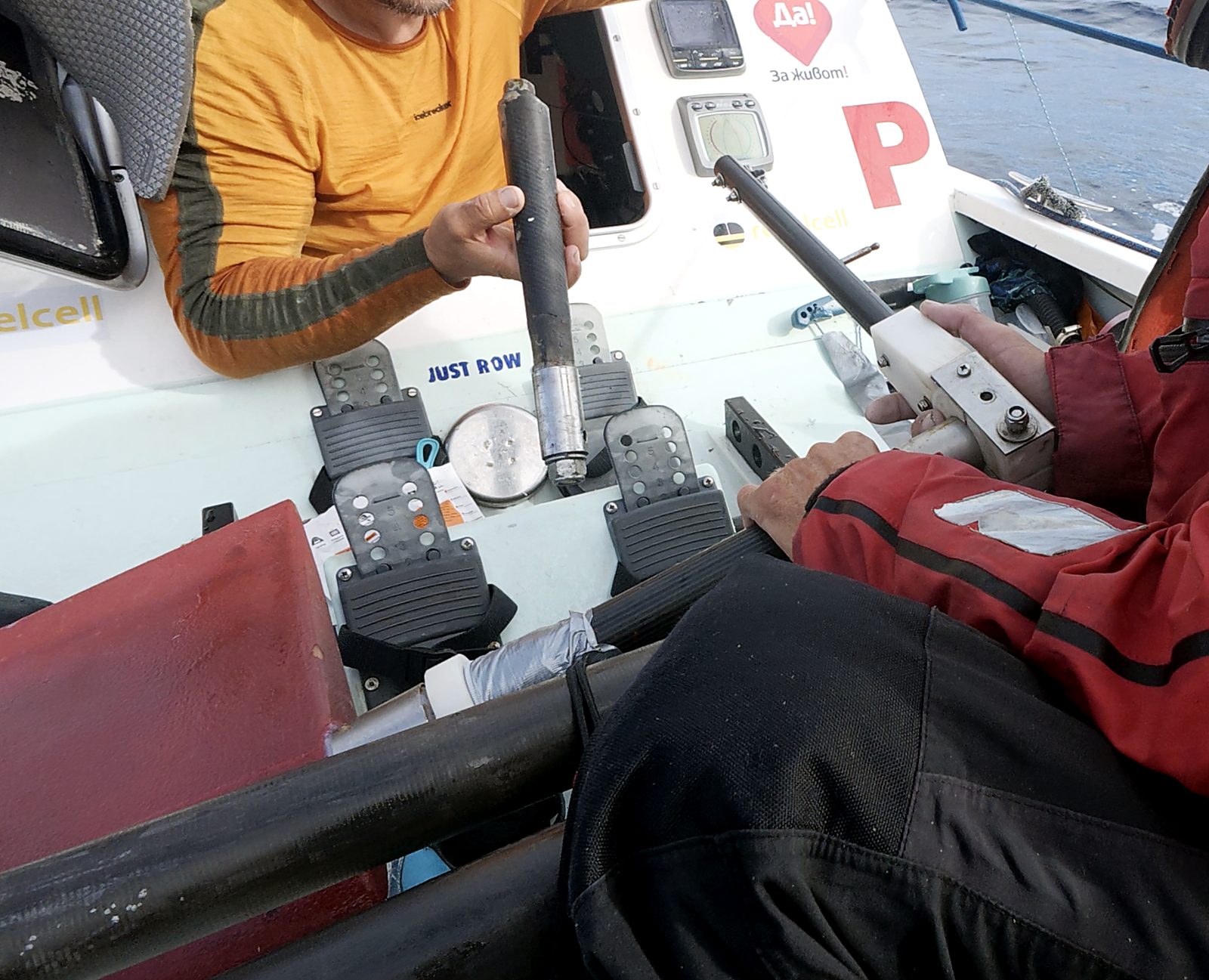
Then we faced a choice between pride and seamanship. We chose seamanship. A spare rudder was brought from Europe and handed to us at sea from a motorboat, 134 nautical miles offshore, on ropes, with no other assistance. We installed it ourselves in twenty minutes and rowed on. Two days later we reached Africa.
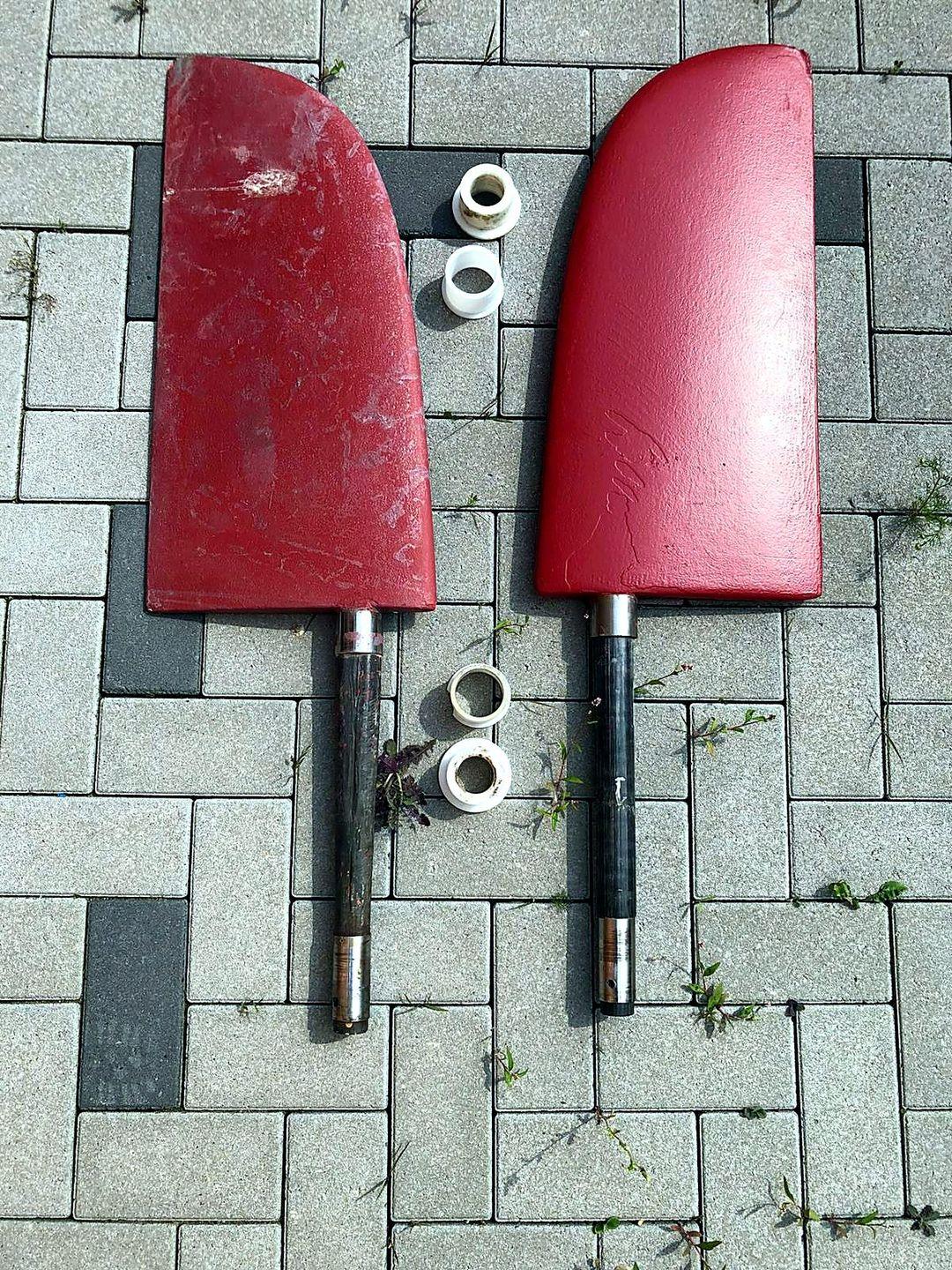
Meanwhile in the Netherlands: the replacement rudder set, photographed while we were still at sea. It was brought to Tanzania and reached our boat aboard the Queen of Zanzibar.
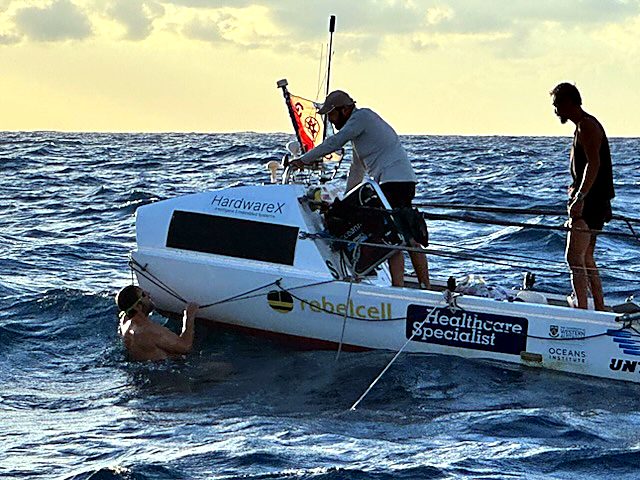
19 July 2025: fitting the replacement rudder, 134 nautical miles offshore.
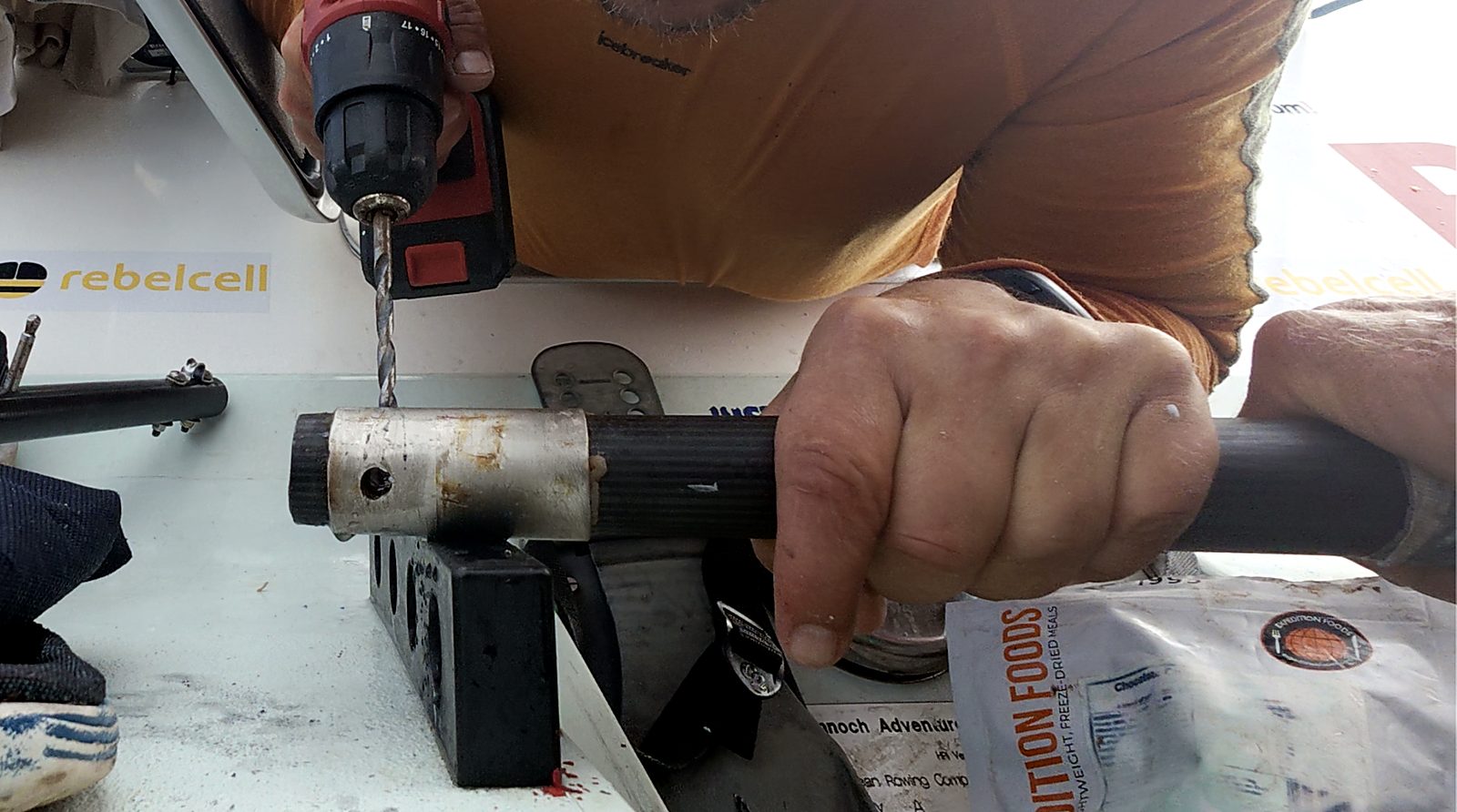
We reported the rudder replacement ourselves. The Ocean Rowing Society classified the crossing as "supported", and the first-team title went to a crew that finished four days after us. Our team does not agree with this decision: in qualifying "first" expedition records, exceptions to the rules have been made repeatedly before. Personally, I have many questions about this decision and about the objectivity of the organisation. To this day we do not even know who actually made the decision: all communication, from registration to the rejection of our paid protest, was handled by one and the same coordinator.
Here is what we took home instead of a certificate: endurance is not about nothing breaking. It is about what you do when everything does.
The logbook
17 May, 09:15 UTC. Four rowers leave Carnarvon, Western Australia.
6 June. The main rudder breaks at 04:00. A coin flip decides who dives; two days later the spare is fitted.
18 June. The centreboard breaks.
12 July. A night knockdown at about 01:20; Liu goes overboard on his line and is pulled back. At dawn the underwater camera confirms: spare rudder and centreboard gone. Nine days to the finish.
12 to 19 July. Seven days of rowing backwards.
19 July, about 14:00 UTC. A replacement rudder is handed over on ropes from a motorboat, 134 nautical miles offshore. Installed in twenty minutes.
21 July, 19:57 UTC. Landfall at the Yacht Club of Dar es Salaam, Tanzania. 65 days, 10 hours, 42 minutes by our onboard tracker; 65 days, 6 hours, 45 minutes as listed by the Ocean Rowing Society.
What the crossing is recognised as
The Explorers Club, the New York institution whose flag has flown on Everest, at both poles and on the Moon, wrote to us after the finish: "congratulations ... on the successful completion of your historic rowing expedition across the Indian Ocean, the first of its kind from Australia to Africa."
We carried Explorers Club Flag No. 33 for the entire crossing. The expedition report was reviewed and accepted by the Club.
Ours is the earliest known team crossing of this route. Honesty about firsts matters to us: in 2023 Robert Barton rowed the same route alone, 85 days solo from Carnarvon to Dar es Salaam aboard Hope. We are proud to be the second boat, and the first team, ever to complete it.
Science on board
The boat was a floating laboratory as well as a home. Throughout the crossing we collected plankton samples for the Biology Department of Sofia University, supporting research on how global warming affects ocean food chains.
An onboard data logger, developed with the University of Western Australia, recorded high-resolution data on wind, position and boat dynamics. The full story is on our Data Logger page.
Your ocean
The expedition gave us tens of hours of footage from multiple cameras, from the preparations and departure through to the arrival, and a logbook of hard lessons.
Since the preparation stage, Evgeniy has been working on an independent feature documentary about the expedition: the training, the ocean, and everything that came after. The film is now in post-production and will be released when it is ready.
But the real cargo was the proof. Blisters heal. Doubt fades. What stays is the reason you started.
Everyone has an ocean of their own: a business, a comeback, a distance, a fear. Our 65 days are an argument that you can cross yours.
Follow the story on Instagram and @untamed.team.
A note on authorship: this page is my personal account and my personal position, and it may differ from the views of other members of the team. I am the author of this page and the de facto owner of this website. Evgeniy Sudyr